
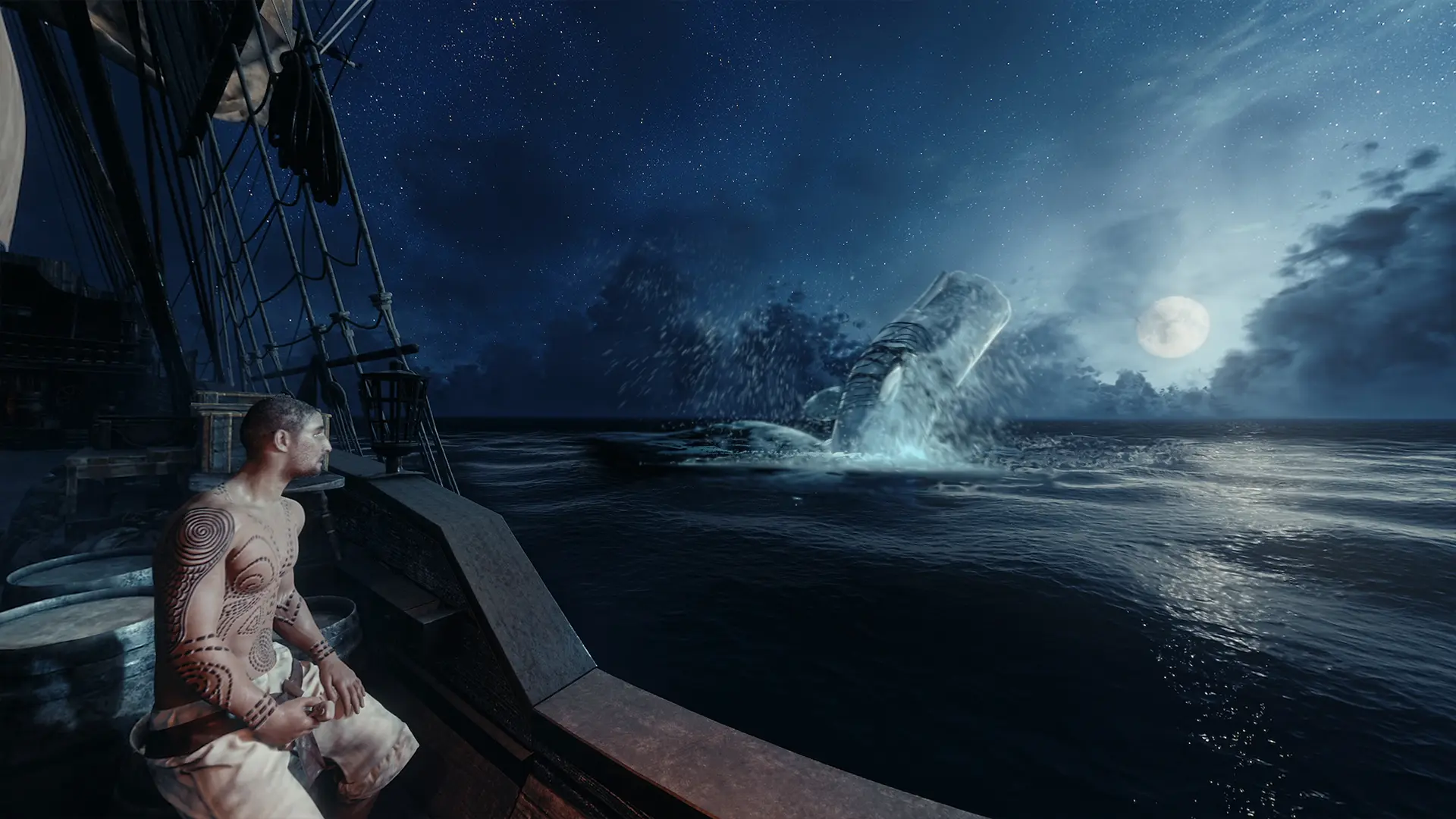
In recent years, the way we experience art, history and entertainment has changed profoundly. It's no longer enough to look at a work behind glass or read a caption: audiences want to step inside the story, move through space, become the protagonist. That's exactly what immersive virtual reality experiences offer, a formula that combines advanced technology with cultural storytelling to turn the viewer into a traveller. In this guide we explore what these experiences really are, how they work and why they are redefining the relationship between people and culture.
An immersive experience is a form of engagement in which participants are not left as passive spectators, but are enveloped by an environment specifically built to engage several senses at once. The key word is immersion: the feeling of truly being inside a place, an era or a work of art. This effect is achieved by combining images, spatial sound, narration and, in its most advanced forms, direct interaction of the body with the surrounding space.
Unlike a traditional exhibition, where the route is linear and viewing is front-on, an immersive experience rebuilds an entire world around the visitor. The most sophisticated immersive experiences use virtual reality to push this principle to its limit: once you put on a headset, you are transported into a complete three-dimensional scene, free to look around a full 360 degrees and, often, to walk around and interact with your surroundings.
The concept of immersion is not entirely new (think of the great painted panoramas of the nineteenth century, or the frescoes that enveloped the viewer), but digital technology has multiplied its possibilities. Today we can speak of a genuine spectrum of immersion: it ranges from projections on large surfaces that surround the gaze, all the way to fully navigable virtual reality environments, where visitors can move and act. The more a system engages the senses and responds to a person's movements, the higher the degree of immersion and, consequently, the intensity of the emotion felt.
Visual immersion is often accompanied by sound and, in some cases, even touch. Three-dimensional audio recreates the position of sound sources, while vibrations, air currents or changes in temperature can accompany the scene to make it even more believable. This multisensory stimulation is what distinguishes a truly immersive experience from a simple projection: the more coherently the senses are engaged, the more the mind accepts the scenario as real and lets itself be carried away.
Virtual reality (VR) is a technology that generates a three-dimensional digital environment in which the user can immerse themselves using a headset. Understanding what virtual reality is helps explain why VR experiences are so much more engaging than any flat screen.
At the heart of the system is the headset, a wearable device fitted with two high-resolution displays, one per eye, which recreate the perception of depth exactly as it occurs in natural vision. Motion sensors add to this, tracking the position of the head and body: when you turn or move, the scene changes accordingly, in real time. Spatial audio completes the illusion, making sounds appear to come from the correct direction. The result is what experts call a "sense of presence": the brain, receiving consistent stimuli from sight, hearing and movement, accepts the virtual space as real.
In the most advanced cultural installations, VR is free roam: physical and digital spaces coincide, so participants can walk freely across a large area, alone or in a group, with no cables or restrictions. This is the most complete form of immersive experience, because it adds real body movement to the visual reconstruction.
From the participant's point of view, the experience is surprisingly natural. Within moments of putting on the headset, the brain stops perceiving the device and accepts the virtual space as a real environment: you look up to see a sky, turn to follow a sound, reach out towards an object. No technical skill is required and the learning curve is immediate, because the interaction mirrors the gestures we make every day. It is precisely this naturalness that makes immersive experiences accessible to an extremely wide audience, from children to the elderly.
Immersive technologies are often confused with one another, but they follow different logics. Knowing the difference helps in choosing the right format for any cultural or corporate project.
Virtual reality completely replaces the surrounding environment with a digital one: once the headset is on, the real world disappears and you enter an entirely constructed scene. Augmented reality (AR) does the opposite: it preserves the view of the real world and overlays digital elements onto it (text, images, three-dimensional objects) visible through the screen of a smartphone or dedicated glasses. Mixed reality, finally, merges the two worlds: virtual elements not only overlay reality but interact with it, recognising the surfaces and objects of the physical environment.
A concrete example helps to pin down the differences. With augmented reality, framing a painting with a smartphone, we might see information and animations appear superimposed on the real artwork. With mixed reality, a virtual character could move around furniture actually present in the room. With virtual reality, on the other hand, the room disappears completely and you find yourself inside the painter's studio, free to explore it. For cultural experiences, virtual reality remains the most powerful technology, because it allows the complete reconstruction of vanished places, distant eras or inner worlds, from a painter's garden to nineteenth-century Milan, with a degree of immersion impossible to achieve otherwise.
It is in the cultural field that immersive experiences reveal their most fascinating potential. Virtual reality makes it possible to overcome the physical limits of a museum or an exhibition: you are no longer bound to what is preserved within a single room, but can reconstruct any context, bringing works, places and figures from the past back to life.
A visitor can thus step inside a painting and see the world through the artist's eyes, or witness the birth of a musical work as if present at the very moment of its creation. This is the approach that characterises experiences such as Inside Monet, which transforms Impressionism into an immersive journey through the painter's places and colours, or You Are Verdi, which brings the great composer's story and music to life in the first person.
The value of this approach is not merely spectacular. Immersion generates emotional engagement and, as a result, far deeper retention of content: you remember what you have experienced, not just what you have seen. This is why immersive experiences are also gaining ground in education and teaching projects, as a tool capable of making culture accessible, participatory and unforgettable for audiences of all ages.
Immersive experiences also have the merit of breaking down some of the typical barriers to cultural engagement. They bring art closer to people who don't normally visit museums, speak a language that new generations understand, and make complex content accessible without trivialising it. For cultural institutions, they therefore represent not just an attraction, but a concrete tool for showcasing heritage and expanding audiences: an increasingly central theme for museums, foundations and local organisations.
A further advantage concerns conservation and outreach. Virtual reality makes it possible to reconstruct fragile works, inaccessible sites or environments that no longer exist, making them available to the public without any risk to the originals. Culture thus becomes safer to pass on and, at the same time, easier to tell: a valuable balance between heritage protection and openness to new visitors, which explains the growing interest of museums and institutions in these technologies.
Italy is today one of the most vibrant settings for immersive experiences dedicated to culture, with a rapidly growing offering in the country's great art cities. Milan and Turin, in particular, are home to some of the most advanced installations, where virtual reality meets the great themes of art history and music. To navigate the options available, you can explore the full range of immersive experiences from WAY Experience, ranging from art to history to music.
Those in the Lombard capital can explore the city's offerings in more depth in our dedicated guide to immersive exhibitions in Milan in 2026. In any case, the advice is always the same: choose an experience designed with care, where technology is not an end in itself but serves the storytelling. It is in this balance between innovation and content that an immersive experience truly becomes memorable, leaving a memory that lasts well beyond the moment of the visit.
Virtual reality immersive experiences are not a passing trend, but a new grammar for how we experience culture: more participatory, more emotional and closer to people. Understanding how they work is the first step towards choosing, and designing, experiences capable of moving audiences and leaving a lasting impression.
Events, groups and schools
segreteria@wayexperience.it
Custom Projects
aziende@wayexperience.it
Customer care
info@wayexperience.it
Via Pordenone 8
20132 Milan
Italy
WAY Srl | CF e P.IVA 10728950964
Privacy Policy | Cookie Policy | Cookie preferences | Public Grants