
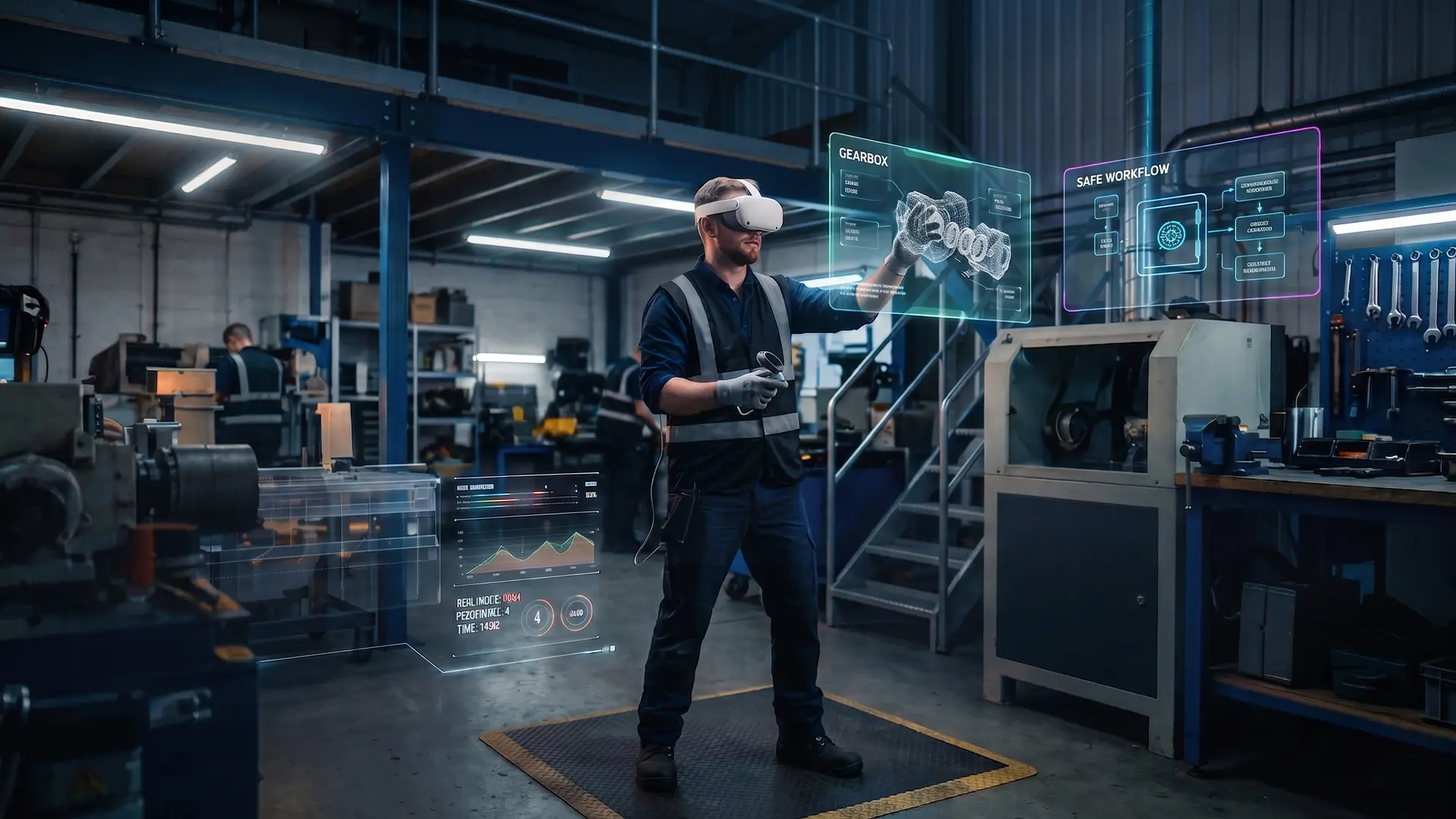
For large organisations, training is both a necessity and a considerable expense. Onboarding thousands of employees, keeping skills current and ensuring consistency across sites are perennial challenges, and traditional methods often fall short on engagement and retention. Virtual reality is emerging as a powerful answer. By letting employees learn through realistic, repeatable practice, VR training improves outcomes while addressing the scale and consistency problems that large organisations face. Here we examine the main use cases, the benefits and how to measure the return.
The effectiveness of VR training rests on a well-established principle: people learn best by doing. Reading about a procedure or watching a video creates passive, fragile knowledge; performing the task — even in a simulation — builds the kind of practical, durable competence that transfers to the real world. Virtual reality allows this learning by doing to happen safely, at scale and as often as needed. Immersion also drives engagement and retention. Because a VR scenario commands full attention and carries emotional weight, learners remember it far better than they would a slide deck. Studies of immersive learning consistently report higher confidence and better recall, alongside faster completion times. For organisations training large numbers of people, these gains compound into a meaningful difference in capability across the workforce. A further reason immersive learning works is the safety of failure. In a virtual environment, a learner can make a mistake — mishandle equipment, misjudge a situation, give the wrong answer — and experience the consequences without any real-world harm. This freedom to fail and try again is one of the most powerful conditions for learning, yet it is rarely available in conventional training, where errors can be costly or dangerous. VR turns mistakes into lessons rather than liabilities.
The applications of VR training span almost every industry. In manufacturing and energy, it allows workers to practise operating complex or hazardous equipment without risk. In healthcare, clinicians can rehearse procedures repeatedly before performing them on patients. In retail and hospitality, staff can practise customer interactions and handle difficult scenarios in a controlled environment. Logistics, transport and field service organisations also find immersive training valuable, since it lets staff rehearse complex sequences and rare emergencies that would be impractical or unsafe to stage in reality. Across all these sectors, the common thread is the same: VR excels wherever practice matters, wherever mistakes are costly, and wherever consistency across a large and dispersed workforce is hard to achieve through conventional means. Beyond technical skills, VR is increasingly used for so-called soft skills: leadership, communication, difficult conversations and diversity and inclusion training. These scenarios are notoriously hard to teach through conventional methods, yet immersive simulation lets learners practise them realistically and receive feedback. Safety and compliance training, often dull and quickly forgotten, also benefits enormously from the engagement and realism that immersion provides. Onboarding is another area where large organisations are seeing strong results. New joiners can be introduced to a workplace, its culture and its procedures through an immersive experience before they ever set foot on site, arriving better prepared and more confident. For organisations that recruit at scale, this consistency of induction is invaluable: every newcomer receives the same thorough, engaging introduction, regardless of when or where they join, which helps embed a shared culture across a dispersed workforce.
Compared with traditional approaches, VR training offers several distinct advantages for large organisations. Consistency is one of the most valuable: every employee, regardless of location, receives exactly the same high-quality experience, eliminating the variation that comes with different trainers and venues. Scalability is another — once developed, a VR programme can be deployed to thousands of learners without proportional increases in cost. There are practical savings, too. VR reduces the need for travel, physical equipment and instructor time, and it removes the risks and disruptions associated with training on live systems. Perhaps most importantly, it allows unlimited practice: learners can repeat a scenario until they have mastered it, something rarely feasible with real-world training. Together, these benefits make immersive learning not just more effective but, at scale, more economical. A further advantage lies in the data immersive training produces. Because every action a learner takes within a scenario can be recorded, organisations gain a detailed picture of how their people perform — where they hesitate, what they get wrong and how quickly they improve. This visibility, impossible to achieve with a classroom session or an e-learning module, allows training to be refined continuously and helps identify skills gaps across the workforce before they become operational problems.
Measuring the return on training investment is a long-standing challenge, and VR is no exception — but immersive programmes also generate rich data that makes evaluation more tractable. Completion rates, time to competence, error reduction and improved performance on the job are all observable indicators. The principles involved are explored more fully in our guide to measuring the ROI of immersive experiences. To build a credible business case, it helps to establish a baseline before deployment and to track the same metrics afterwards, comparing immersive training against the methods it replaces. Linking training outcomes to business results — fewer safety incidents, faster ramp-up, higher quality — turns a soft benefit into a measurable one. For organisations under pressure to justify budgets, this evidence is precisely what unlocks wider adoption.
An effective VR training programme is built around the specific competencies an organisation needs, not adapted from a generic template. WAY Experience works with large organisations to design bespoke immersive training, from defining objectives and scenarios through to production and rollout. You can explore our approach to custom immersive projects to see how a tailored programme takes shape. For organisations in France and Switzerland, Italy’s proximity makes on-site collaboration straightforward when needed. As the technology matures and the evidence mounts, VR training is moving from experiment to standard practice — and the organisations adopting it now are building a more capable, confident and consistent workforce for the years ahead.
Events, groups and schools
segreteria@wayexperience.it
Custom Projects
aziende@wayexperience.it
Customer care
info@wayexperience.it
Via Pordenone 8
20132 Milan
Italy
WAY Srl | CF e P.IVA 10728950964
Privacy Policy | Cookie Policy | Cookie preferences | Public Grants