
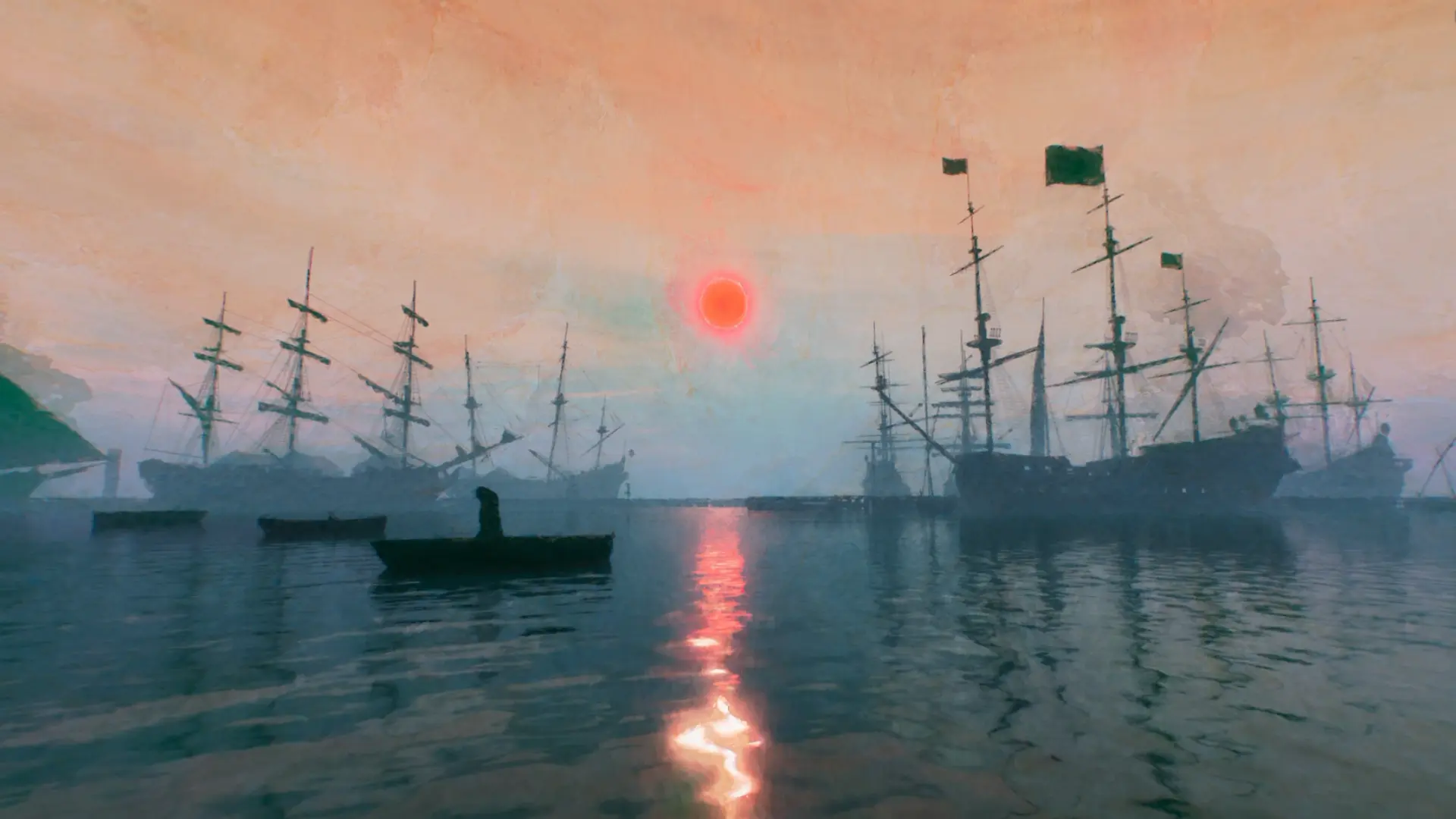
Few artists have changed the way we look at the world like Claude Monet. Widely recognised as the father of Impressionism, Monet turned painting into an inquiry into light, atmosphere and the fleeting moment, leaving behind works that are among the most loved and recognisable of all time. Understanding who he was and why his paintings continue to captivate millions of people is the best way to prepare to experience his art up close, including through the new immersive forms that technology now makes possible.
Oscar-Claude Monet was born in Paris in 1840 and grew up in Le Havre, on the Normandy coast, where the ever-changing light of sea and sky shaped his eye from the very start. As a young man he made a name for himself with caricatures, but it was meeting the painter Eugène Boudin that steered him towards painting en plein air, out in the open, far from the studio. It was a choice that would become the heart of his entire career: painting from life, chasing the variations of light at different times of day.
Having moved to Paris, Monet came into contact with a group of young artists (including Renoir, Sisley and Bazille) who shared his impatience with academic rules. These were years of financial hardship and rejection by the official Salons, but also of intense experimentation. Monet was not seeking the polished detail and flawless finish demanded by the academy: he wanted to capture the immediate impression of what he saw, the sensation of an unrepeatable moment.
His was a career marked by tenacity. For much of his life Monet had to struggle against poverty, critical incomprehension and personal loss, without ever abandoning his own vision. Only in his later years, with the international success of the series paintings and the Water Lilies, did he receive the recognition that had long been denied him. This perseverance is an integral part of his appeal: the man who imposed a new way of seeing the world just as the world was struggling to accept it.
The term “Impressionism” itself was born, almost as mockery, from a work by Monet. In 1874, at an independent group exhibition, the artist showed a painting titled Impression, soleil levant: a view of the port of Le Havre wrapped in the mist of dawn. A critic, in a scornful tone, labelled “impressionists” those painters who seemed content to sketch impressions rather than paint finished pictures. The name, coined as an insult, became the banner of a movement.
What united the Impressionists was a new way of understanding painting: quick, visible brushstrokes, pure colours placed side by side without blending, and absolute attention to light and atmosphere rather than to drawing. Monet was its most radical and consistent interpreter. For him, the subject (a cathedral, a haystack, a pond) was almost a pretext: what really mattered was how the light transformed it from hour to hour, from season to season.
This revolutionary approach also emerged thanks to concrete factors of its time. The spread of paint in tubes allowed artists to paint comfortably outdoors, while the emerging art of photography freed painting from the task of faithfully representing reality, pushing it to explore what the camera could not capture: perception, emotion, the moment. Monet knew how to interpret this shift better than anyone else, making the fleeting nature of light the true subject of his art.
Monet’s career is dotted with masterpieces that have shaped the history of art. The series paintings are perhaps his most original contribution: painting the same subject many times, in different light conditions, to study every metamorphosis. This is how the cycles dedicated to the Haystacks, the Poplars and, above all, Rouen Cathedral came about — portrayed dozens of times from dawn to dusk, until its stone dissolves into pure luminous vibration.
Alongside the series, works such as Impression, soleil levant, La Grenouillère and the views of the Seine define the visual vocabulary of Impressionism: reflections on water, shifting skies, figures captured in the flow of modern life. These are paintings that, seen up close, break down into patches of colour, but that from a distance recompose the magic of a real moment.
To help you navigate the exhibitions dedicated to these masterpieces, our guide to the immersive exhibitions in Milan in 2026, where art and technology meet, can be useful.
In 1883 Monet settled in Giverny, Normandy, where he created, with almost obsessive care, the garden that would become the subject of his last great creative season. The water lily pond, the Japanese footbridge, the willows reflected in the water: this corner of nature, shaped by the artist himself, became an open-air painting laboratory.
The Water Lilies, hundreds of canvases painted over almost thirty years, represent the pinnacle of his research. In his final years, despite serious eye disease, Monet created panels of monumental scale in which space expands and the viewer seems to be immersed in the water, amid reflections and blooms. These works, now housed in museums such as the Orangerie in Paris, remarkably anticipate much of twentieth-century art and speak an almost abstract language.
Precisely because Monet’s painting is made of light, atmosphere and immersion, it lends itself, like few others, to being experienced through immersive technologies. Literally stepping inside the Water Lilies, walking through the garden of Giverny, watching Rouen Cathedral change colour before your very eyes: this is the experience we offer with Inside Monet, a virtual reality journey that recreates the sensory dimension of the Master’s masterpieces.
The experience is also available for audiences in Piedmont with Inside Monet Torino e Inside Monet Genoa, designed to bring Impressionism closer even to those who have never seen a work in person. Virtual reality doesn’t replace the original painting, but amplifies its emotional understanding: you perceive the scale, the movement and the sense of immersion that a simple reproduction cannot convey.
It’s worth remembering that 2026 marks the centenary of Monet’s death — he passed away on 5 December 1926 in Giverny — an anniversary celebrated, across France, Italy and the rest of the world, by an extensive programme of exhibitions and events. It’s the ideal occasion to rediscover the Master, including through an immersive experience that captures the full emotional power of his work.
Knowing the life and works of Claude Monet is the first step towards appreciating his revolution; experiencing his masterpieces immersively is the most engaging way to make them your own. Between art history and direct experience, the legacy of the father of Impressionism continues to speak to a new, curious and ever-growing audience.
Events, groups and schools
segreteria@wayexperience.it
Custom Projects
aziende@wayexperience.it
Customer care
info@wayexperience.it
Via Pordenone 8
20132 Milan
Italy
WAY Srl | CF e P.IVA 10728950964
Privacy Policy | Cookie Policy | Cookie preferences | Public Grants